Unlike the Haber-Bosch process which produces anhydrous ammonia, this process produces aqueous ammonia.
Here I will start at the last steps and then work back toward the first ones, this is so you don’t waste your time trying to understand a process that doesn’t result in the product promised.
The way you make the ammonia is actually very simple.
You run a hydrogen powered internal combustion engine very fuel rich. i.e. with massively more hydrogen than you need for combustion.
The exhaust gases from an internal combustion engine run this way contain steam from the burnt hydrogen, nitrogen from the air and unburnt hydrogen fuel.
The exhaust port on the combustion chamber has a valve that will only open when the pressure in the combustion chamber exceeds the pressure in the exhaust pipe.
The exhaust pipe is attached at the other end to a pressure vessel, which will henceforth be called the production chamber.
In the bottom of the production chamber is a condenser. It is sited at the bottom due to convection making the base of the combustion chamber the coolest part.
The purpose of the condenser is to remove the steam from production chamber gases. This is possible because water has a much higher boiling point than nitrogen and hydrogen. This also determines the temperature of the production chamber which must be slightly higher than the boiling point of water at that pressure.
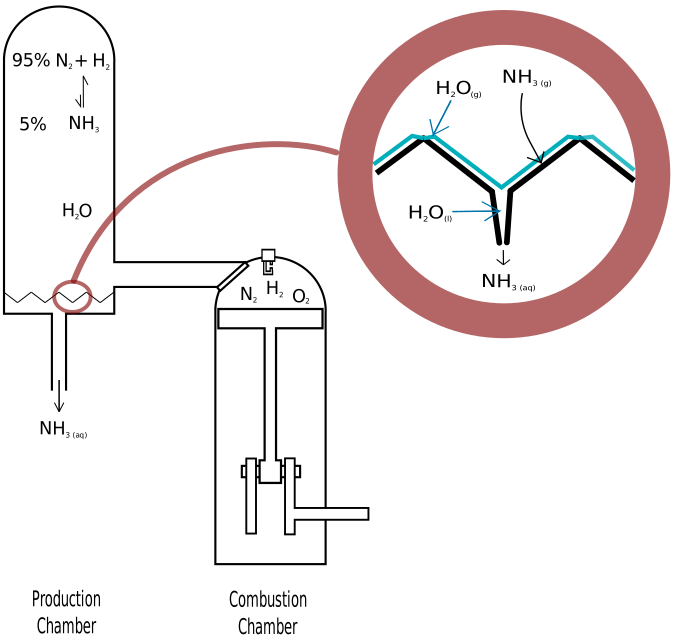
The condenser is cooled by the pressure drop between the production chamber and atmosphere.
The act of condensing the steam leaves a film of water on the condenser, before gravity takes the water to the bottom of the condenser and out of the production chamber.
The nitrogen and hydrogen under high pressure in the production chamber react in a reversible reaction to produce ammonia.
The equilibrium point of this reaction is approx. 5% ammonia to 95% hydrogen and nitrogen.
However unlike the hydrogen and nitrogen the ammonia is highly hydrophilic so promptly dissolves in the water film on the condenser and then is removed from the production chamber with the water.
As the ammonia is constantly removed from the reactants in the production chamber the equilibrium point is never reached.
Consequently a catalyst is not required, unlike in Haber Bosch.
This is how your ammonia is produced.
Next Page