 process.
In all these pages I hope I have made it clear that I did not create this synthesis I reverse engineered it from the original plant.
It is important that you understand how the engine works from first principles before I tell you about the existing plant.
Now you should understand how the Soris engine works.
Compare the schematic of the Soris engine with a cross section of the Red Pyramid see below.
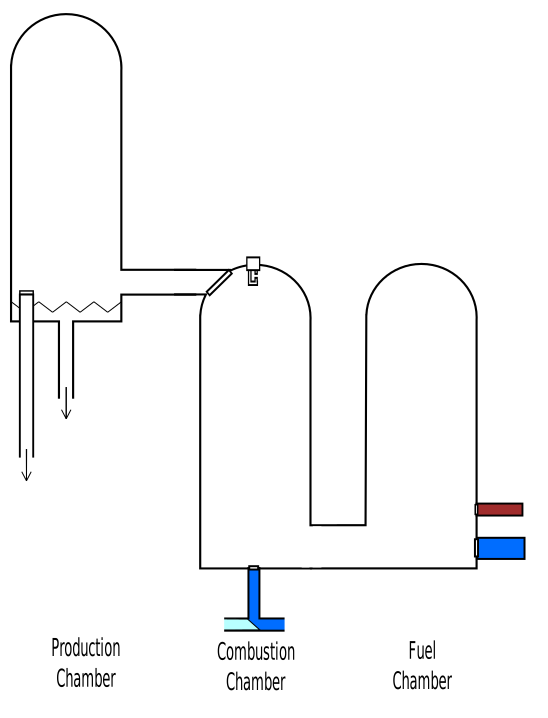
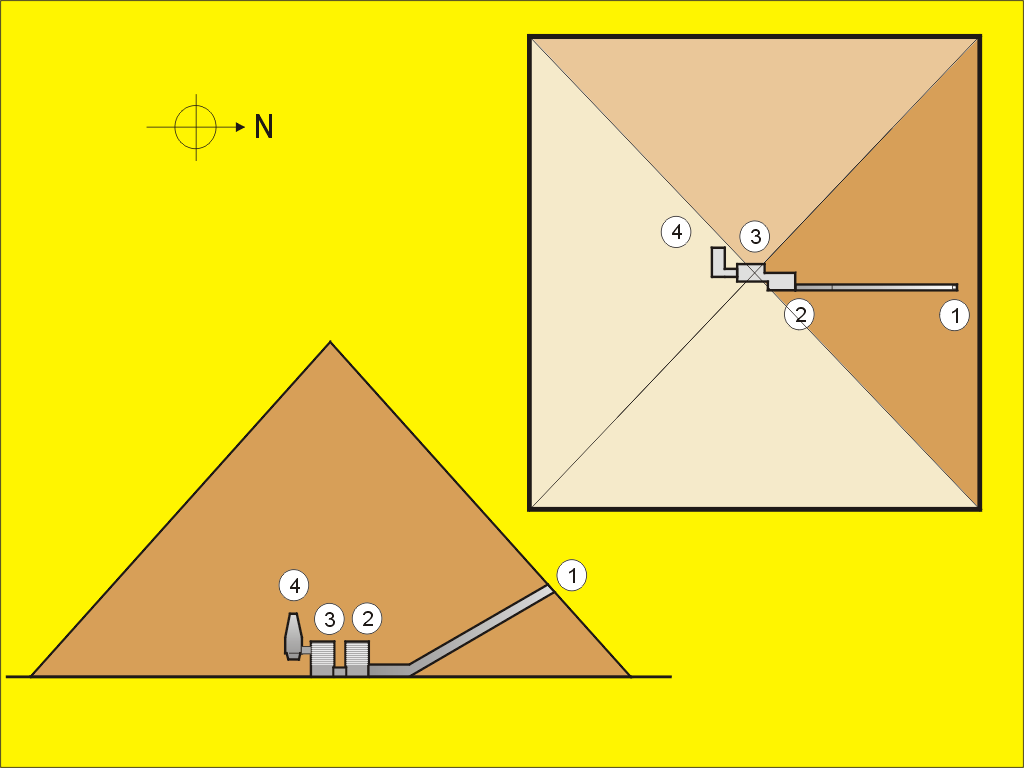
Then ask yourself how you would build a series of pressure chambers?
If
Now look back at that cross section. If not fully convinced lookup some youtube shorts of the 'red pyramid' and see if you can see structures that have to be in the Soris engine and have been removed or hidden, valves, condensers etc.
Yes I’m aware that creates a dramatic re-evaluation of history but that is outside the scope of what I am discussing here, fascinating though it is.
Other miscellanea -
I haven’t discussed how they ignited the hydrogen in the combustion chamber, originally I thought that they used something akin to a Brown-Bess flint lock mechanism, the pressure in the chamber causing the trigger pull. Mounted in the upper divots.
Later I thought they may have gone high tech and used something akin to a Wimshurst machine, but my impression is that their understanding of electricity never progressed beyond late 18th century understanding of static charge. No electrical insulators have ever been found from that period in Egypt. Again mounted in the upper divots.
I’m now of the opinion that they went super low tech and mounted a metal bar to the side of the combustion chamber the bottom of the bar being bronze, the top iron.
They attached to the bar a metal float with a flint or similar rock mounted to the top which as the water piston rose pushed along the bar causing sparks but only when pushed across the iron. Mounted twice at the top (the upper divots) due to the forces involved and once at the bottom (the lower divot)
Today we’d just use a spark plug, far simpler and more reliable.
When the scrap metal men got at the condenser they used acid to dissolve the rock holding it in place. (This should also tells us what metal the condenser was made from.) In order to create an acid bath they had to cast a stone plug over the ammonia outlet and argon vent pipes otherwise the acid would not stay in the production chamber. That is why today there appears to be no way for the ammonia product to leave the pyramid.
I should thank Ben van Kirkwyck for pointing out that the official story of the old kingdom does not fit with the period’s historical artefacts. Geoffrey Drumm for the Drumm Hypothesis - That pyramids are industrial scale chemical factories, and all his first rate exploring of these sites and Marcel Foti for discovering how the concrete was made.
Finally if a name must be given for ammonia synthesis done by the Soris engine let it be the
Philip - process.